I need to apologize here for letting the blog slide below my day-to-day horizon. It's been a crazy couple of weeks, work-wise and whatever else, and I see it's been a week and a half since my last post. Yikes.
Let's look at another couple of pages from
Dragonfly.Pacific Crossing
The pier, a great concrete semicircle,
stretched into San Francisco Bay
like a father's arm around a daughter.
On Sundays, we would venture on that pier,
Mama in her broad straw hat, a country
woman in some rice paddy on Luzon.
In his lucky lime-green short-sleeved shirt, checked
by orange pinstripes, Papa would heft the net.
I would lean over the rail, watch the two
steel hoops — the smaller within the larger,
criss-crossed by heavy twine in diamond shapes —
loft out over the dark water and sink
in a green froth. A small wire cage nestled
in the center of the hoops, containing
chunks of raw meat. Papa would say, "Best bait
is porterhouse. Crabs really go for that."
Sometimes he would let me pull the net up.
The rope slimy and tight in my small hands
and then the skitter and scuttle of claws
on the wooden deck of the pier. Later
at home, I would play the radio loud, hide
that same skitter on the sides of the large
enamel-white Dutch oven, concentrate
instead on the sweetness I knew would come.
One of those Sunday evenings, I dropped in
at my friend Peter van Rijn's house. Dinner
had just been served, and the family rule
was: all the neighborhood kids had to leave.
|
|
Page 10 | |
But I didn't. There was Pete's father, like some
patriarch from a Norman Rockwell painting,
poising his carving knife above the shell —
huge and bountiful — of a red King crab.
I said, "Wait." Their heads swiveled toward me
in shock, as if I'd screamed a curse word out.
Old Peter, the daughter Wilhelmina, his sons —
Paul, Bruno, Guido, my friend Pete —
the Mom whose given name I never knew:
a good immigrant family. The heirs
of European culture, I always
thought, these direct descendants of Rembrandt.
I said, "Wait." And then I shared the secret
passwords to being a Filipino.
Here is where you dig your fingernails in
to pry the top shell off. You suck this green
and orange jelly — the fat of the crab.
This flap on the underside tells if it's
male or female: pointed and skinny or
round like a teardrop. Here's how you twist off
legs, pincers. Crack and suck the littlest ones.
Grip it here and here, then break the body
in half. These gray fingers are gills — chew but
don't swallow. Break the crab into quarters.
Here you find the sweetest, the whitest meat.
|
|
Page 11 | |
The first half of this poem describes one of my fondest childhood memories: crabbing with the family. I've never been one for fishing, I gotta say, but crabbing, now there you've got something! My dad really did use steak for bait — porterhouse, no less — rather than something like chicken (which many people use); that gesture is part of his devil-may-care, aristocratic attitude.
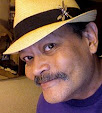
This is a guy who (thought he) looked like the movie and TV actor Dick Powell
. . . a not uncommon sentiment among Filipinos of his generation, that they resembled white celebrities. The famed Filipino writer Bienvenido Santos, in fact, wrote a novel titled
The Man Who (Thought He) Looked Like Robert Taylor. Below is my father's passport photo from the late 1940s, next to a picture of Dick Powell, a crooner in 1930s movies and later a film-noir tough guy in the 1940s (he played the detective Philip Marlowe in the 1944 movie
Murder, My Sweet.) You decide if there's a resemblance. I guess the point here is that Papa thought of himself, of Martin Avila Gotera, in romantic terms, and that carried through into everything he did, even crabbing.
Back to the poem: the details and feelings I connect here to crabbing are pretty much an unadorned recounting of how I felt. I really enjoyed those lovely family moments even though when I was a child it disturbed me that we would cook the crabs alive. For those of you not used to seafood, this boiling crabs alive is how it's done by everyone, not just Filipinos, something to do with eating crab safely. The crabs you can order for shipment to you are also cooked alive and then frozen.
Okay, by now, you're probably wondering who the third guy is in the pictures above, the one to the right of Dick Powell. That's the greatest Dutch painter, Rembrandt van Rijn, a self-portrait painted in 1630 when he was in his mid-20s.
As the poem says, my oldest childhood friend, Peter van Rijn, is a direct descendant of Rembrandt, and I was always awed by that ancestry. But then there are other kinds of knowledge, and in the poem the speaker shares expertise the van Rijns didn't know, the
"secret / passwords to being Filipino." Believe me: you don't want to cut a crab open with a knife; you'll have sharp, pointy shell bits mixed up with the meat.
For what it's worth, this dinner and crab event really happened. Though I did take one small liberty: the poem says the van Rijns were eating a "red King crab" — probably a red Alaska King crab. In all likelihood, they would have served a Dungeness crab, the most common crab typically eaten in California. You can probably recognize this in the pictures below of an Alaska King crab on the left and a Dungeness crab on the right; the King crab looks like some kind of space alien from a B-movie. Here's why I chose to use "King crab" in the poem: it's a very expensive crab, and I liked the word "King," emphasizing the
"heirs / of European culture" connection I wanted to highlight.
That admission of a poetic liberty taken with the story is pretty much all I'll say about craft in the poem. Obviously it's in free verse, though we've got quatrains or four-line stanzas rather than the more usual verse paragraphs to emphasize meaning. 'Nuff said.
Okay, wanna know what you should do next? Go eat some crab. Maybe King crab legs. Expensive, yes, but well worth it. Better yet, get a whole crab, rather than crab meat that's been extracted by stainless steel gadgets. There's something magical and fun about getting your hands dirty while eating crab. Whatever you do, steer clear of faux crab, imitation crab meat.
If you've never eaten crab by hand before, check out these
instructions from Instructables.com; but also follow my tips in the poem, which will become easier to apply if you look at the Instructable pictures. Remember, no knives. Also, the online instructions say, "Remove and discard the spongy, inedible gills"; as I say in the poem,
"chew but / don't swallow" — try it. The Instructables write-up says, "Rinse the greenish-brown goo out of the body"; don't do it:
"suck this green // and orange jelly — the fat of the crab," says the poem. You won't be sorry.
One little aside. Look again at the pictures above of my dad, Dick Powell, and Rembrandt: don't you think the bottom half of Papa's face resembles Rembrandt's? Hmmm. Nah, just kidding, just kidding! Thanks for reading the blog.
Oh, wait. Another little aside. Check out the picture below of a coconut crab doing a little dumpster diving. Well, not a dumpster exactly, but a common household garbage can. Scary, don't you think? You probably don't have a pot big enough to cook this bad boy.
And this crab definitely
is a bad boy. I'd hate to meet this guy in a dark alley. I'd hate to meet him anywhere. But with all the coconut he must eat to get this big, I bet he would taste pretty damn good!
Just so we can all feel safe taking out the trash later, let's leave off with a picture where human beings are firmly in charge of the crabs.
That's a scene from San Francisco's world-famous Fisherman's Wharf: a sidewalk vendor's crab stand, where you can walk up and get as much crab as you can stand. Hmmm-hm. See you down at the wharf, then?
Photo credits: The picture of San Francisco's Municipal Pier at the top is from yelp.com, taken by Ed "Mr. Peabody" U. The next picture, of a full crab net, is from the Beachstumps website. The third picture is from the Instructables.com instructions on "How to Cook and Clean a Fresh Dungeness Crab." The next picture, of a person holding a live crab, is a San Francisco Chronicle file photo from SFGate.com. The fifth picture, of a whole cooked crab on a plate, is courtesy of PDPhoto.org. The sixth picture, of a quarter crab plus legs served up on a plate, is again from Instructables.com. The photo of Dick Powell is a detail from an image on fanpix.net. The self-portrait by Rembrandt (1630) is from Wikimedia commons. Also from Wikimedia Commons are the pictures of the Alaska King Crab and the Dungeness Crab. The picture of the coconut crab on the garbage can be found all over the internet; just google "coconut crab." I found it in the blog Loko's Domain. The last picture, of a Fisherman's Wharf crab stand, is also from Wikimedia Commons.



 Posts
Posts


