
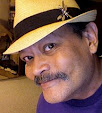
The next poem in Dragonfly is the last Vietnam-war-focused one. It's a sestina with a lot of alterations in the cycling end-words. This poem has its own separate blog post here where the specifics of the sestina-making are discussed. By the way, this poem needs a trigger warning: a derogatory word for Asian appears in it, a word that is here because this is soldier talk from the '70s. I have not changed this word because it is true to the voice of this character (and it is a character, not myself). More on that below. Page 40 Page 41 Going back to my previous blog post on this poem in 2009, I wrote this: Many readers misinterpret this poem as being spoken by a grunt in Vietnam, a combat veteran. The central conflict of the poem orbits around the speaker not having gone to Vietnam. In fact the title of the poem is US governmentalese for someone who served in the US armed forces during the war but was not sent to Vietnam. Although this poem uses many autobiographical details from my own life, this speaker is a persona, not me at all. I personally don't feel this way about not having been sent to Vietnam; in real life, my father, even though he was quite the proponent for Army and veteran service, did not want me to fight in that war because he felt the war in Vietnam was wrong. Okay, despite the poem not being fully autobiographical, I am indeed a Vietnam era veteran, and here's a picture from my US Army service in the 1970s, when I was stationed at the Presidio of San Francisco.
As always, I'd love to get some feedback or discuss anything with all y'all. Comment, okay? Thanks. Ingat.
|
Showing posts with label vietnam war. Show all posts
Showing posts with label vietnam war. Show all posts
Tuesday, March 4, 2025
Dragonfly (pages 40-41)


Monday, March 3, 2025
Dragonfly (pages 38-39)
At this juncture in Dragonfly, a poem about how war and military service were seen in 1980s America, as evidenced by a news story from 1987. Page 38 Page 39
This poem was occasioned by my seeing on TV news a drill team of men wearing business suits and carrying briefcases on Veterans Day in 1987. I can't recall now if I made up the name "Wall Street Drill Team" or if I maybe had actually seen the Fred Hill Briefcase Drill Team pictured above. Either way, drill was seen in that 1987 news show as comedic rather than ceremonial. As always, I'd love to get some feedback or discuss anything with all y'all. Comment, okay? Thanks. Ingat.
|

Sunday, March 2, 2025
Dragonfly (page 37)
The next poem in Dragonfly was originally inspired by The Tunnels of Cu Chi, a book by Tom Mangold and John Penycate (1985). When I taught at Humboldt State University, starting in 1989, I met David Shaw, a Native American veterans' counselor at the university, and he told me about his US Army service in Vietnam where he was a tunnel rat. Thanks to David for some of the details in this poem. Page 32
David Shaw is an Apache and joined the US Army during the Vietnam war in order to fulfill his tribe's cultural traditions of being a warrior. During that war, there were many Native Americans who joined the service for that very reason. Tom Holm's book Strong Hearts, Wounded Souls: Native American Veterans of the Vietnam War, discusses that phenomenon as well as how Native American soldiers often had an easier readjustment back to civilian life from their tribal ceremonies to heal warriors after war. Check out the two books I mention in this post about fighting in Vietnam. As always, I'd love to get some feedback or discuss anything with all y'all. Comment, okay? Thanks. Ingat.
|

Saturday, March 1, 2025
Dragonfly (pages 35-36)
At this point in my book Dragonfly, I turn toward several poems focused on war, specifically the Vietnam war. Page 35 Page 36
On Halloween 1963, I would have been eleven years old, and this poem draws from actual memories of my friends and me trick-or-treating. We were probably not very much aware of the American war in Vietnam heating up at that point, though ironically we would have been playing at being soldiers at war, as we did in real life. The fictional French woman I imagined for this poem would have been about our age when her father died in the French war in Vietnam nine years before. And of course for these boys, the Vietnam war would soon be very present in their lives, in American life in general, as the closing image of the poem suggests. As always, I'd love to get some feedback or discuss anything with all y'all. Comment, okay? Thanks. Ingat.
|

Tuesday, March 31, 2009
Keeping Six Words Tumbling in Air
Okay, one more of my poems from Asian American Literature, the textbook edited by Shawn Wong, for the benefit of the UGA students with whom I've been interacting (see the last two posts) and now my own students in our Asian American Literature course (at the University of Northern Iowa) who are about to start discussing my poems in that same textbook.
Vietnam Era Vet
A fragrance remembered is Vietnam —
the acrid odor of gunpowder and tracer fire,
smudgy cooking fires in every hooch, the pungent scent
of nước mắm and water buffalo shit, a father's
acid sweat as he searches for his lost son
in some ville, smoking from an H&I strike — all this was my wish.
I'd look at my class A's in their plastic bag in the closet and wish
sometimes I too had been to the 'Nam.
I remembered basic training at Fort Ord, double timing in the sun
to the range. "Ready on the left! Ready on the right! Fire
at will!" Late nights in the latrine, I wrote my father
long letters about being afraid I'd be sent
over there. Everyone in the platoon was afraid of being sent,
but not one of us admitted it. "Sure wish
they'd ship me over to that motherfucker,"
we said to each other in the noonday light, "Vietnam —
can't wait. Shoot me a fucking gook or two, fire
mortars all goddamn night." Papa'd write back, "Son,
let God's will be done. Just be a good son.
Just do your job. If they send you, then they send
you. That's all." And I'd lie on my dark bunk and smoke — the fiery
tip of the cigarette curling like a tracer ricochet — wishing
I loved it all. C-rations, the firing range, the memorized Vietnamese
phrases, my leaky shelter half on bivouac. All for Papa.
That was as close as I would get to my father's
war. I'm sure my grandfather called him a good son,
both in the U.S. Army, the Philippine Scouts. Their Vietnam
had been Bataan. When the sergeant would send
my father out on point, did he wish
even for a moment that he hadn't joined up? Did artillery fire
make him cringe in his foxhole? That time he was caught in crossfire,
did he try to will himself into a tree, a rock, a bird? Papa,
I knew only the mortar's crump and whoosh,
the parabolic path reaching up to California sun.
I never knew the shrapnel's white-hot whistle at arc's end.
Two nights ago, I dreamt I was in Vietnam:
a farmer runs for the tree line — I fire a crisp M-60 burst — Vietcong,
for sure, for sure. The LT sends me up to verify. In shimmering sun,
Charlie's face is the one I wash in my helmet. No. It's your face, Papa.
— Vince Gotera, first appeared in The Journal of American
Culture (1993). Reprinted in Asian American Literature:
A Brief Introduction and Anthology (1996). Appeared
also in Fighting Kite (2007).
Some brief footnotes. In line 6, "H&I" stands for Harrassment and Interdiction: indiscriminate artillery fire at the enemy to break their morale; of course, this procedure caused a great deal of so-called "collateral damage," i.e., injury and death among civilians and noncombatants. Ain't military terminology as fun as a barrel of junkies? In line 7, "class A's" are semi-formal Army uniforms, similar to a suit and tie. A "shelter half" refers to half of a pup tent (line 24); two soldiers would team up to make up a single tent for bivouac or encampment. The Philippine Scouts (line 27) were an elite
Let's focus on craft and technique first. The salient point here is that this poem is a sestina. If you don't know this poetic form, the sestina repeats the ending words of each line in the sestets (six-line stanzas) so that they eventually appear at the end of every possible location (the first line of the sestet, the second line, etc.). Then the repeating words (called repetons [REHP-uh-tawns) appear in a three-line stanza (known as an envoi [own-VWAH]), two words per line, one at the end of the line and the other in the middle.
The repetons are re-used in the stanzas in a preset pattern. The matrix below shows the cycling of this particular sestina's repetons — Vietnam, fire, scent, father, son, and wish. I've color-coded the words so you can follow their movement through the stanzas easily.
Vietnam fire scent father’s son wish | wish 'Nam sun Fire father sent | sent wish motherfucker Vietnam fire son | son send fiery wishing Vietnamese Papa | father’s son Vietnam send wish fire | crossfire Papa whoosh sun arc’s end Vietnam | Envoi sends sun wash Papa |
As you can see, I "cheat" by altering the repetons occasionally (this is pretty common practice among contemporary writers of the sestina). For example, "Vietnam" becomes "'Nam" in stanza 2, "Vietnamese" in stanza 4, and finally "Vietcong" in the envoi. Almost always sestina alterations are done through consonance ("wish" ——> "whoosh" ——> "wash"). I'm pretty proud of how, in stanza 6, the "sent"/"send" sound is rendered by "arc's end" — cool, eh? I'm even more proud (perversely so) of "father" becoming "motherfucker" . . . a kind of literalist double entendre. And there is even a basis here (admittedly distant) in rich consonance: /f/ and /r/ in
Okay, on to content. Many readers misinterpret this poem as being spoken by a grunt in Vietnam, a combat veteran. The central conflict of the poem orbits around the speaker not having gone to Vietnam. In fact the title of the poem is US governmentalese for someone who served in the US armed forces during the war but was not sent to Vietnam. Although this poem uses many autobiographical details from my own life, this speaker is a persona, not me at all. I personally don't feel this way about not having been sent to Vietnam; in real life, my father, even though he was quite the proponent for Army and veteran service, did not want me to fight in that war because he felt the war in Vietnam was wrong.
So why did I write the poem? I had read and was wowed by a story titled "The Persistence of Memory" by Walter Howerton, Jr. (from an anthology called The Perimeter of Light). Howerton's excellent story focused on a Vietnam-vet wannabe driven by a deep need to connect with his WWII-vet father, now dead, who had condemned him for being an anti-war activist during the Vietnam war. After reading this bravura story, I wondered if I could write something similar using elements from my own life. So essentially "Vietnam Era Vet" is an imitation that ultimately transcends imitation. At least I hope so.
There is one final concern to air. In my last post I talked about my decision to revise "Alan Valeriano Sees a Lynch Mob" by replacing the n-word with two other alternatives. The same issue surfaces here. What about the word "gook" in the third stanza? I would assert that the "g-word" is necessary here to convey the devil-may-care language and 'tude put on by young soldiers; at the same time, in terms of poetics, "gook" carries the /oo/ assonance in "shoot" and "two" . . . as well as the /k/ consonance in "can't" and "fucking." I suppose you might say I'm contradicting myself. Well, I would have to stand with Whitman then: "Do I contradict myself? Very well, then I contradict myself, I am large, I contain multitudes." Amen.
NOTE: I have intentionally not included any visual images in this blog post. We get too many images of war as it is. Blank space, in writing (and in life), has many virtues.
I would also like to offer my apologies to color-blind people who probably had a hard time with the color-coded matrix above. I wish there was another way to do that kind of diagramming without leaving you out.
Thursday, February 5, 2009
Dragonfly (page 6)
Okay, back to the serializing of Dragonfly. And, to continue the insect connection, as in my recent beetle-on-a-string theme, this time we focus on the dragonfly. This poem is in fact the title piece of the collection.
Page 6 NOTE: Image sources at right, from top to bottom: |
|


There is indeed a brand of rice called "Dragonfly." I tried really hard to find an image online of the bag it comes in but came up empty-handed; you'll have to take my word for it that the bag is indeed marked with the word dragonfly in several Asian languages. On the bag also is a primitive-looking rendering of said dragonfly, and the whole shebang is labeled "Tutubi Milagrosa." I saw a bag of rice just like this in an Asian food store, and that started up this poem.
Now, tutubi (too-too-BEE) is the word for "dragonfly" in Filipino (or Tagalog, as the poem says), and milagrosa is Spanish for "miraculous" — a word imported wholesale into Filipino. Putting two and two together, then, I thought the rice bag said, "miraculous dragonfly." In fact, the word milagrosa, it turns out, refers to a type of rice, so the bag is quite pedestrian in declaring its contents as tutubi-brand milagrosa rice. Nonetheless, the misunderstanding — the resonant phrase "miraculous dragonfly" — fueled in me a mindstorm of meditation and memory, and this poem is the happy result.
First, a couple of facts. If you read the first installment of my ongoing bio in the blog, you know that I was born in the US but also lived some years as a small child (fact one). This poem is set during that time, just like the poem "Beetle on a String," posted on 1-30-2009.
Fact two. You can catch a dragonfly in your hands. This poem is my most-anthologized poem, and it has appeared in several language-arts textbooks for middle school and grade school; I have also performed this poem for students at various middle schools and grade schools, and this is what kids (and adults, I'm guessing) always want to know: can you catch a dragonfly? And how do you do it?
Look at the pictures of dragonflies above; you'll see that their thorax, the part of their body behind the head is quite bulky, containing the musculature for the wings. Although dragonflies have these gynormous compound eyes and probably have much better peripheral vision than we do, I don't think they can see behind themselves. That bulgy thorax gets in the way, like a bulky backpack. Now, I haven't checked with an entomologist on this, but I'm pretty sure I'm dead on here.
So, find a dragonfly that's landed; line yourself up with the tail, so you're directly behind the insect; then sidle up and grip the dragonfly by its tail between thumb and forefinger, ever so gently of course. Now this makes dragonflies really mad, but just hold on. I learned recently that the safest way to hold a dragonfly, so you don't harm it and it doesn't harm itself thrashing, is to bring the wings together above the insect and use them as a kind of handle. The bottom picture above demonstrates how to do that.
Try this out the next time you're near dragonflies; you'll be amazed at how easy it is. But of course, do let the dragonflies go. Don't keep them in a jar and try to feed them plant stuff. They are carnivores and must catch their prey, other insects, on the wing. Even if you put insects in the jar with them, they won't be able to catch them because they have to do it while flying. So don't keep them very long. In fact, it's best to let them go right away.
Fact three. (And this is a confession.) When Mary Ann needed a dragonfly for a model when she was working on the book cover, I went out and caught one. (She didn't actually think it could be done; who says you can't learn practical facts from poems?) We kept it in a jar and tried to feed it. But no go. It died, alas. So I know whereof I speak from actual experience. And my penance is to tell people not to keep dragonflies. Besides, here's a little fact that might intrigue you. The dragonfly forms a cage with its legs and uses it to scoop and trap other flying insects. That's why it can't catch another insect inside a jar, not enough room to get up some speed.
By the way, there's a cool story (fact four) behind Mary Ann's dragonfly illustration for the cover (top image above). She spent a summer drawing dragonfly after dragonfly and although they were wonderful renderings, I thought, Mary Ann was never satisfied. One day, she ripped a dragonfly shape out of white construction paper. She liked it okay, but the color seemed wrong. So Mary Ann pasted it down on another sheet of paper and painted the dragonfly black. After she let the black dry, she lifted up the dragonfly and the black part of the image above was what was underneath, on the throwaway sheet. Mary Ann simply added the turquoise accents, and there it was.
Okay, enough with the facts. "Just the facts, ma'am." Oh, wait, I wanted to add about Mary Ann's art experience that I just love how accident and serendipity can be such important aspects of art; another way to say it is that art can often be a gift to the artist. From the universe, from God, from whatever greater benevolent force you may believe in. And we, the artists, are just a conduit for that grace.
Changing gears. I'm teaching a course in Beginning Poetry Writing right now, and we're at that inevitable point in class when (some of) the students assert that a writer can be universal, can reach the widest audience, by being vague and ambiguous. The argument goes like this: readers won't identify with one's specific detail because it will contradict their own detail, their own memories, so one ought to write generally in order that readers can inject their own feelings into the poem. Nothing could be further from the truth. The poet must provide her own concreteness, and write those details out of her own life so that they glisten and scintillate with her own experience and vision; readers find joy in those specifics, feel that they are in capable hands, and trust the poet to "bring it." Ironically, it is at moments like this that readers bring in their own details, noting how they resonate with the specifics the poet has laid out.
I hope you can see this dynamic at work in this poem. Note in the second stanza the details of "metallic globes for
Ditto with the war vs. nature stuff in stanza three: "silky jungle mist" vis-à-vis
In the second half of the poem, there are details that are more closely related to the specifics of my own life: "a four-year-old's handspan from wingtip to wingtip"; "the Rizal monument" (José Rizal is the national hero of the Philippines, so there are both personal and national references in this passage); "cicadas." And much more specific and personal: "khaki shorts, a scrape on one knee." These details are designed specifically to ground the poem (and the reader, of course) in verisimilitude, in an apparent reality, to help them feel as if they are "there." Although perhaps someone may not have worn khaki shorts, everyone will have had abrasions and bruises. So a common humanity is invoked by these small details.
In the final stanza, I start to include general ideas, notions that aren't concrete: "his whole being," "a small universe," and "utter beauty and grace." But notice that this is one stanza out of six, and the earlier five act as contextualizing ballast: all the Asian languages mentioned in the opening stanza, for instance. This transition from the specific to the general allows the speaker then to reveal: "his hand, my hand." And the last line returns us to specific detail: "intricate shimmer of wings, the eyes iridescent jewels."
As we used to say in poetry workshops of the 70s and 80s, the poem earns the right to use large, universal concepts by anchoring the poem first in concrete detail and then re-anchoring the poem at the end with concrete detail.
Once again, though, let me remind you that the writer is never the best source about his or her own writing. So I would love to hear what you think about all this; leave me a comment below. Or if you have questions, ask away. Thanks. I hope you are having a truly marvelous day today.
|
Monday, November 24, 2008
Autobiography (1.0)
From time to time, I am contacted by students or researchers who are studying my poetry or fiction, and they often ask questions about my life. So I am going to give a brief bio here for those students and others who may be interested.
On June 20, 1952, I was born Vicente Ferrer Gotera in the NCO Club at the Presidio of San Francisco. Well, that's not exactly true. That date is right but the building was the Obstetrics Clinic of Letterman Army Hospital
My parents were both Filipino American immigrants to the US: Martin Avila Gotera and Candida Fajardo Gotera. My father would eventually become a lawyer and my mother was already an MD when I was born (I believe).
I was born in a US Army hospital because my father was a retired Army officer, a second lieutenant who received a battlefield commission, meaning he had performed some feat of extraordinary leadership while in combat
After receiving medical care in the US for combat fatigue in 1946, Martin went back to the Philippines but had to return periodically to the US to re-establish residency in order not to forfeit his naturalized US citzenship. When he met Candida he was in San Francisco on one of those residency trips.
My mother was in the US because she had gone to Stanford University for her medical training (all or part, I’m not certain about). Dr. Fajardo's specialty was pediatrics, and she practiced medicine in the Philippines some time later
In 1951, Martin met Candida Fajardo in the basement of a downtown San Francisco bank. He had heard women's voices speaking Tagalog and followed their refreshing lilts until he saw Candida (nicknamed Dading) with her sister Clara. They were immediately attracted to one another, though Clara said, "Watch out for that one — he’s trouble."
Well, I guess he was trouble
I'm not sure what year my parents moved to the Philippines, I think for my father to study for his law degree, which he earned from the University of the Philippines, I believe. My mother practiced medicine during this period. And to some degree, they had to "lay low" because divorce was not legal in the Philippines and so my father was technically in violation of the law for having married my mom. In the eyes of the law, he would have been considered a bigamist.
In Manila, I went to St. Theresa's School for kindergarten and then to San Sebastian College for first through third grade. It was during first (or maybe second) grade that I wrote my first poem. My father and I were on a ferry boat crossing Manila Bay (I believe); it was early morning, and I distinctly remember noticing the sun, how bright it was and round. The poem was written in quatrains, I recall, rhyming abcb
In the meantime, my father was having professional trouble; the Philippines had enacted a law preventing American citizens from practicing law there, presumably because American lawyers who had trouble passing the bar in the US would go to the Philippines to practice. This left my father in a lurch because he didn't want to give up his American citizenship.
We moved to San Francisco in May 1962. I was nine years old. And I went to St. Agnes School for fourth through eighth grade. It was during this time that I started to go by the name "Vince"; I found that so many people had trouble with my given name "Vicente," wanting to put an "n" between the "i" and the "c." I later went to St. Ignatius High School, which became St. Ignatius College Preparatory while I was a student there.
My mother did not practice medicine after we moved back to the US. And neither did my father practice law
In late 1970 or early 1971, I had some early literary successes. I won a city-wide essay contest for high-school students, though I can't recall now what that prize was called. That essay was published in the Philippine News, an expatriate (anti-Marcos) newspaper based in San Francisco, along with four or five poems. I was fortunate to have really excellent English teachers at Saint Ignatius
I particularly thank Mr. Bob Grady (now Fr. Grady) for his creative writing assignments in junior and senior English. Write a story like Sherwood Anderson in Winesburg, Ohio. Imitate an e. e. cummings poem. And just straight-out creative writing prompts. I remember in particular one classmate who turned in the lyrics to "Cloud Nine" by the Temptations and got an A. For the most part, though, most of us wrote those poems and stories and plays in serious fashion for Mr. Grady, and I learned a tremendous amount in his classes.
During my high school years, also, I played lead guitar in several rock bands that gigged at teen club and high school dances across San Francisco. I remember a couple of band names: Doomsday Refreshment Committee, Change of Heart, and Peace of Mind come immediately to mind. My guitar god was Carlos Santana, and I remember playing the solos on his records over and over, working them out note by note, riff by riff, chord by chord.
When I became of draft age, my number in the draft lottery was 30. This meant that we men born on June 20 would be drafted 30th during the year to come. Really, 30 was a terrible number if you didn’t want to be drafted; consider that there were 336 birthdays that got lower priority.
I entered Stanford University in 1971 with that 30 hanging over my head. And that was also the year that student deferments were abolished. So
And there was another factor involved. My girlfriend, Ivania Velez, was pregnant. We married in January 1972. I needed a job to support the two of us and the baby that was on the way. I left college in March 1972 and enlisted in the Army in April 1972.
In June 1972, just a few days before I turned 20, my first child was born: Martin Adan Gotera. I was in Basic Training at the time at Fort Ord, not far away from San Francisco, and so fortunately I was able to be present for Ivon’s labor and Marty’s birth. I remember that was a gala occasion. My father, who wrote a column titled "Of This and Such" for the Philippine News, really outdid himself with a very joyful and enthusiastic announcement of Marty’s birth.
My Army service was fairly uneventful. It was wartime
When I was discharged from the service in April 1975, I took a job as a civilian employee at the Presidio’s Finance and Accounting Office, where I had worked as a soldier. After a couple of years, I became the Supervisor of the Reserve and National Guard pay division; I remember my own incredulity as I, not even 25, would authorize and sign payrolls worth millions of dollars. It still seems surreal to me now.
In the meantime, on the family front, my mother had grown steadily more ill. Ivon and Marty and I lived with my parents at that time so that Mama could spend as much time as possible with us (especially Marty). In 1976, Mama passed away, having outlived the doctors' estimates of how long she had left to live.
I'm going to stop there for now, and continue the bio in a later post. At this moment I want to share the elegy I wrote for my mother about a decade or more after she died.
Hospital Thoughts, Last Year and Today
Last Christmas Eve, I woke to see Mama, dead
twelve years, bending over me in that strange bed,
but no, it was just those pale hospital green
walls, the yellow daze of fever. I'm seeing
things, I thought. But it must have been like that
for my father, a woman with blue-black hair in whites
bending over him during morning rounds,
like the Tenente and Cathy in A Farewell to Arms.
Around them—like a 1940s black-
and-white flick—the war. Sirens and ack-ack
guns, Manila covered with a shroud of smoke
again. General MacArthur returning like
an iron bloodhound, the Japanese kneeling by the sea.
When I was nine, that's how I'd wanted it to be.
I didn't want my parents to meet in a bank
in San Francisco, Tagalog words like magnets
drawing them together. But that Florence
Nightingale bedside scene never took place.
Those knotted hospital sheets tight around my chest,
I recalled Mama's cancer. How doctors christened
her a "model" patient. Once a pediatrician,
she had already fingered all their talismans:
chemotherapy, radiation treatment,
her hair falling out, her body shucking off weight.
At Carew and English, Papa and I found
she'd already ordered a shiny cedar coffin.
Now my father lies in a VA ward in
California—when I visit, he is skinny
as a nine-year-old boy, legs like useless sticks.
He speaks of the war, the Bataan death march,
how thin he'd gotten in the concentration camp.
He tells me how he misses Mama sometimes.
More desperately than his hand on my hair, I want
to see my mother in white, next to the window,
the stethoscope gleaming round her neck.
The sun glints in her hair, full and black.
— Vince Gotera, first appeared in the Seattle Review.
Reprinted in Men of Our Time: Male Poetry in
Contemporary America (1992).

With regard to my poetics, I would probably highlight my employment of slant rhyme here. First, clearly there are full rhymes: "dead" and "bed," "black" and "ack." There is one instance of pararhyme (or consonantal rhyme, a là Wilfred Owen): "want" and "window." There are also quite acceptable slant rhymes, such as "that" and "whites," or "neck" and "black." But then I also use some very distant rhymes: "rounds" and "arms," "bank" and "magnets," for example. I really wanted quite a bit of diversity in the rhyming. And also my trademark "roughed-up" pentameter.
Basically, I wanted couplets that any formalist could recognize as rhymed couplets but which proponents of free verse would think was free verse. I wanted the best of both worlds in what was at that time, in the 1980s, an armed-camp atmosphere between the free-verse poets and the so-called neoformalists. As in so many contexts, I played at being the joker, the wild card.
Friday, November 21, 2008
O Brother, Where Art Thou?
My father was a laconic man. I don't mean to say that he didn't talk much
Here's a classic example: one time when I was a teenager, a young man knocked on our door and asked to see my dad. I showed him into the living room and went to get Papa. Who then peeked into the living room and hustled me into the dining room, where he whispered in my ear, "That's your brother." I had no inkling that I had a brother.
It turns out my father had been married to another woman before Mama and had two sons from that marriage
Here's a poem about my brother Pepito, another Gotera who was a soldier in the US Army.
A Soldier’s Letter out of the San Francisco night, a stranger
To my brother: When I was fifteen, you surfaced
knocking on our door. Your family
a mystery kept from me, a wife and kids
from another face in my father's secret mirror.
You stayed with us for two or three nights, a dark
and glum presence, brooding at the dinner table.
Mama didn't seem shocked at all. Those nights
we lay in my room, listening to the Sopwith Camel
and the Stones on KFRC, and you softly crooned
the melody. Once you asked who Jesus
was — why did we light candles to him?
At the end of the week, Papa drove you to
the Army Recruiting Station. And Vietnam
swallowed you whole. No news for six months, and then
your letter came. The one in which you threatened
to disembowel Papa with your bayonet, to blow him away with steel shot from a Claymore, to lock and load your M-16, then shoot him dead. Dead for leaving you and your Mom
alone in Manila. Where she took you and your brother
down to the bay and hugged you tearfully
until she saw St. Jude floating over
the water. A miracle. Your lives saved.
And now, in the 'Nam, your life had again been spared
by the vision in air of a woman in a white ao dai.
You jerked your head back in surprise, and the sniper's
bullet lopped off a leaf where your face had been.
And so you believed your hophead's life was sacred.
No rocket, no mortar round could pierce the armor
of revenge, the righteous shield of vengeance.
I vowed to make myself strong, to take
taekwon-do lessons, to save my father's life
when you rotated home. But moments pass
like buckshot, and when you finally landed at Oakland,
you went on back to LA, without stopping again
at our door. The letter — a reefer fantasy.
Today, the letter forgotten, you live in our father's
house, alternating between gay bars
on Castro and the VA hospital psych ward.
Rather than bullets or a C-4 explosion,
you pay our father rent from your disability
check — the proceeds of your post-traumatic
stress disorder syndrome. The last time
we saw each other, you showed Mary Ann your saints,
like a pack of cards. "This picture is St. Blaise &mdash
he saves you from choking on chicken bones. And here's
St. Anthony. I use him to find lost things."
You called the pictures your "directory to heaven."
Nights, I see you in my mind, bowing
before a small Buddhist altar, lighting
sticks of incense, chanting with your eyes closed.
You're thinking back to velvet times in Manila,
when you were a teenage singer on TV,
crooning love songs under a blue spot.
— Vince Gotera, from Premonitions: The Kaya
Anthology of New Asian North American Poetry
(1995). Also appeared in Ghost Wars (2003).

I don't know what to add to this story. Pepito had indeed been a teenage singer in Manila
About the poem as a poem: I worked pretty hard on lineation. A mix of end-stops and enjambment
I would appreciate some feedback about what you think is going on here. If you feel like it, leave me a comment, please. Not a remark for potential revision, because as far as I'm concerned the poem is done and I'm not interested in reworking it. I'm just curious about how people read it &mdash how you read it. And how you make sense of the poetics of this particular poem.
When I wrote "A Soldier's Letter," probably almost two decades ago, Pepito was still alive though we were hardly ever in touch. And now, after he has died, I realize that this poem was, in many ways, already my elegy for him. Rest in peace, Jose Pater Gotera. Rest in peace, my brother.
Subscribe to:
Posts (Atom)

 Posts


