Showing posts with label assonance. Show all posts

Thursday, March 20, 2025

Fighting Kite (page 14)


This poem in Fighting Kite was orginally written in 1998 for an anthology titled Screaming Monkeys: Critiques of Asian American Images, edited by M. Evelina Galang. The backstory of the anthology (described more fully in this blog post) has to do with a 1998 restaurant review in Milwaukee: the reviewer called a Filipino restauranteur's child a "little monkey," setting off an online brush fire of protest by Filipino Americans. Eventually Galang compiled and edited the anthology in reaction and response.


        In birdsong my father strolled the Presidio
of San Francisco, a Filipino in the U.S.

Army, sharp in parade dress, lieutenant's
bars riding his shoulders like sun cresting
clouds. A corporal in dingy fatigues walked

past my father, snickered, kept his right
hand by his hip. "Hold it right there, soldier!"

my father barked. "Where's that goddamn salute?"
The corporal smirked, looked him in the eye and said
nothing, but my father could read it in his face —

I'll be damned before I salute a little brown
monkey who ought to be climbing a fucking tree.


My father growled an order. The soldier jerked
to attention. My father slipped off his jacket, draped it
on a hedge. The rainbow of ribbons reminded him

not of crossfire and the soldier he saved on patrol,
not of the forced retreat to Corregidor,

not of the weeks evading Japanese capture,
not even of the Bataan death march,
nor of the concentration camp. Instead

he recalled the American jeep that tried to run
him down in a rainstorm. Get out of the road, monkey!

My father said, "You might not want to salute me,
young man, but you will salute this jacket, these bars.
Do it!" Birds sang. "Again." Sun shone. "Again."

The corporal's arm swept the air, a wiper blade
trying to swipe brown mud from a windshield.


Page 14


The blog post mentioned above talks about this piece:
The poem itself relates a family story. When my father was stationed at the Presidio of San Francisco immediately after the war, a soldier on the street refused to salute my father (who had been recently promoted into the officer ranks of the US Army). It was quite clear to Papa that the refusal was racist — the soldier, a white man, was not about to salute an officer who wasn't white. So my father took off his uniform jacket and draped it on a nearby hedge, then ordered the soldier to salute the jacket, affixed with lieutenant bars, again and again. Which the soldier did. My father always told this story as a parable about "thinking out of the box," as we say these days.
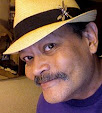
The photo above is a very small snapshot I have of my father in his US Army officer's uniform, in front of the San Francisco Public Library downtown, in 1946, around the time this event happened. I'm sorry it's blurry . . . there is very little detail in the snapshot itself.

In terms of poetic craft, the aforementioned blog post describes how the poem
employs pentameter that has been intentionally "roughed up" [in] alternating couplets and tercets (all unrhymed). I have forgotten why I shaped the poem this way, but the pattern does allow me to produce some useful verse paragraphs, for example, stanzas 5, 9, 10, and 11. At the same time, I also get some nice stanza enjambments: "a Filipino in the US / Army," for example, in lines 2-3, highlighting the problems Filipinos encountered during that time, both in the US Army and in US society overall.
So, basically,blank verse. In the final stanza above, you can see my use of sound effects.
The corporal's arm swept the air, a wiper blade
trying to swipe brown mud from a windshield.
Alliteration and onsonance in the repetitions of SW and P in "swept" and "swipe"; also assonance in the I vowels of "wiper" and "swipe"; and more alliteration and consonance in the B and D in "blade" and "brown mud"; interestingly, because L and R are related (liquid) consonants, there is also consonance of L and R in "blade" and "brown"; finally, notice as well as the preponderance of Ps and Ds throughout the stanza. Fun stuff!


As always, I'd love to get some feedback or discuss anything with all y'all. Comment, okay? Thanks. Ingat.


 FIGHTING KITE  INTROFRONTCONTENTSPREVIOUSNEXTLAST
   

Wednesday, April 12, 2017

Day 12 ... NaPoWriMo / Poem-a-Day 2017


A dozen days of April have elapsed. A dozen poems for a double-dozen prompts. Playing the dozens.

Maureen Thorson’s NaPoWriMo prompt: "write a poem that explicitly incorporates alliteration (the use of repeated consonant sounds) and assonance (the use of repeated vowel sounds)."

Robert Lee Brewer’s Poem-a-Day prompt: "write a guilty poem. The poem can be written from the perspective of someone who is (or feels) guilty, or it can be about someone (or something) else that’s guilty. But guilty of what? Cheating on a test? Or a spouse? Or a diet? Only you know, and only your poem can reveal the truth."


Okay, from me, some over-the-top soundplay — alliteration, assonance, even some consonance, and the occasional rhyme — on the theme of guilt.

No, I Don’t Feel a Bit Guilty

Our president, Tweedledee — or is he
Tweedledum? no, Tweedledrump! —
tweets while the rest of us sleep.
He twiddles his teeny-tiny thumbs
to keep from pressing the red button.
Red is his favorite color, for ties, for party,
and especially the shade of shed blood.
His thumbs couldn’t keep from mashing
buttons to launch Tomahawk missiles.
So does Tweedledrump feel any guilt
for spilt civilian red? Not at all. His approval
rating got a bump up and his stock portfolio
humped higher. No wee-hour tweeting from
Tweedledrump on that. No tweeting on guilt
except guilting folks who worked for Obama.
Trumped-up fake news. Trumped-up drama.

—Draft by Vince Gotera    [Do not copy or quote . . . thanks.]

So the "I" in my title could be Trump (or T___p as some call him in order to make fewer the occurrences of his name in the world since he loves his brand to be invoked repeatedly, whatever the reason) or it could be me . . . but nah, I don't feel guilty at all for writing that.


To set up his confluence of soundplay and guilt today, Alan tells us, "When I returned home Monday, a lone bee was attempting to find the log gum we had moved the day before." Go back a couple of days in the blog for the earlier part of this story in Alan's poem "The Karen Cajka Bees Go to Jonesborough" for Day Ten.

Where Are Those Who Were before Us?

Its trunk of log gum gone with hive,
a lone bee flew to one nearby
as hollow but without the hive
and found no entrance with each try,

a worker lost through cycled sun
a frosty night outside the hive,
not huddled dark and close and warm
like every bee inside the hive,

a bee alone, its purpose gone,
no queen to serve, gone with her hive,
no honeycomb, no beeswax home,
no pollen cell to feed the hive.

What we preserved to move the hive
means more than one lone hive-lost bee
imprinted with the notion “hive”
but vested with sad fate by me.

—Draft by Thomas Alan Holmes    [Do not copy or quote . . . thanks.]

In response to the earlier poem, I had written, "Alan, I hope another queen finds one of your trees to start a hive." Little did I know that there would be a sad outcome of a lone worker bee trying to find the hive that was home. Doomed to be forever lost.


"Sad Bee" photograph by Barry Easton

Friends, won’t you comment, please? Love to know what you’re thinking. To comment, look for a red line below that starts Posted by, then click once on the word comments in that line. If you don’t find the word “comments” in that line, then look for a blue link below that says Post a comment and click it once. Thanks!

Ingat, everyone.   


NaPoWriMo / PAD 2017 • Pick a day:
1 2 3 4 5 6 7 8 9 10 11 12 13 14 15 16 17
18 19 20 21 22 23 24 25 26 27 28 29 30


Saturday, November 15, 2008

Craft and Technique (1.0)


A couple of weeks ago, I posted my poem "Guard Duty" here, but the politics-oriented context of that post didn't really allow for discussion of poetics. Now and again, I get inquiries from students who are writing a paper on some poem of mine, and generally their papers end up covering meaning more than craft. In the interest of informing such seekers about my technique, I'd like now to unpack "Guard Duty" some. Here's the poem again.


Guard Duty


A young soldier squints into thick black night
hoping no hostile sapper is cutting through
barbed wire, a bayonet and grenades tied
to his waist . . . invisible. This mute scenario

lies at the heart of three generations' bedtime
stories: my Lolo and my Papa in the US
Army, Philippine Scouts, death march in Bataan,
my brother Pepito in the 'Nam, nightmares

of Agent Orange. That young soldier could have been
any one of them . . . or me, on guard mount at Fort Ord
during Vietnam. Almost dreaming machine gun
recoil in our hands. Screaming, an oncoming horde.

Never again . . . young women and men should dream
of breezes in trees, soft rain, sunshine. Never again.

Vince Gotera, from Poets Against the War (2003).
Also appeared in my 2003 collection Ghost Wars.

To begin, I should say I subscribe to Seamus Heaney's distinction between craft and technique; craft has to do with building-block approaches, like alliteration or rhyme; technique is the cooperation of craft and personality, one's individual, idiosyncratic use of craft elements. Craft is mechanics; technique is stylistic. Below, I'll be talking about craft; my technique is ultimately for you to decide (it's invisible to me, of course).

SOUND and MUSIC. I am a huge fan of Gerard Manley Hopkins, with his over-the-top sound play. Of course, today you can't use sonic devices like Hopkins did . . . contemporary ears find such sound play fascinating but really just too much. Nonetheless, you can emulate Hopkins to a limited degree. For example, alliteration in stanza one: /th/ in "thick" and "through," "/b/ in "black," "barbed," and "bayonet"; assonance: the short /i/ in "squints," "into," "thick," "hoping," "cutting," "his" . . . and the three instances in the single word "invisible"; consonance: the beginning /s/ and ending /r/ in "soldier," "sapper," and scenario." And all this just in the first stanza.

One of my favorite sonic devices is rhyme. As a faithful student of Emily Dickinson and Wilfred Owen, I tend more towards slant rhyme than full rhyme, thus I rhyme "been" with "gun," "dream" with "again." A là Owen, I even have an instance in this poem of consonant rhyme — what critics call "pararhyme" and Owen called "jump-rhyme" (probably the most famous examples are in his poem "Strange Meeting," where in the first four lines he rhymes "escaped" and "scooped," "groaned" and "groined"). Here in this poem, I rhyme "bedtime" with "Bataan" . . . I'm particularly happy that I was able to involve three consonants: /b/, /t/, and /n/ or /m/, in that order.

An important way to think about rhyme, other than in terms of sound, is to look at what words are rhymed. As a poet, one can hint quite a bit about theme through judicious use of rhyme pairs. For example, I'm quite proud of the pairing of "US" and "nightmares," as a bit of social commentary. Also, not using periods in the abbreviation — like "U.S." — allows the additional meaning of "us" . . . i.e., the plural first person pronoun, as in "you and I," thus extending the social commentary even more.

RHYTHM and METER. In a couple of earlier . . . wait, before we get deep into this topic, let me warn you that it might get a little technical. Don't worry. If you don't know what I'm talking about, see the Wikipedia articles on poetic meter and prosodic feet. Okay, let's get to it.

In a couple of earlier posts, I referred to favoring "roughed-up" meter. In this poem, I use pentameter that is — you guessed it — "roughed up." What I mean by this is frequent substitution of feet; if my primary meter is iambic, I pepper the poem with trochees, anapests, dactyls, even some spondees and pyrrhics.

In fact, I'm not even sure if my primary meter in the poem is iambic. Look at a scansion of the first line:
×
a
/
young
|
/
sol-
×
dier
|
/
squints
×
in-
|
×
to
/
thick
|
×
black
/
night
So . . . iamb trochee trochee iamb iamb. I suppose because the first foot is iambic and three out of five feet here are iambic, you could say we've got iambic pentameter. Well, maybe. I suppose that's as good an argument as any. But I gotta tell ya, I'm not sure myself, really. When I count feet while composing, I pay attention mainly — no, only — to how many stresses are in the line; I let the unstressed syllables sort themselves out. So when I wrote this poem, I bet I never once thought iambic or trochaic or whatever. I did know I wanted pentameter, but that's as much as I thought ahead, probably.

Let's look at another scansion, this time of line 3:
×
barbed
/
wire
||
×
a
/
bay-
|
×
o-
/
net
|
×
and
×
gre-
|
/
nades
/
tied
This is probably as close to true iambic pentameter as you'll find in this poem . . . and it isn't exactly that, either. We've got iamb iamb iamb pyrrhic spondee. And those last two feet are what's called a "double iamb," which count (say the experts) as two iambs . . . I like to think of this construct as a "super iamb" because there are two unstressed syllables followed by two stressed syllables, so you've got a fully unstressed foot heightened then by a fully stressed foot, to get the rising rhythm required by the iamb. In any case, although this line may seem to be straight-out iambic pentameter, it's still not your run-of-the-mill example, particularly because of the caesura (or break in the line, marked here by a comma) immediately after the first foot. And that first foot may not really be an iamb, it turns out; it could be scanned as a spondee: BARBED WIRE || a BAY- | o- NET . . . and so on.

And here's line 7, another interesting example. First off, note the two caesuras (caesurae?):
/
ar-
×
my
||
/
phil-
×
ip-
|
×
pine-
/
scouts
||
/
death
×
march
×
in
|
×
ba-
×
ta-
/
an
A noteworthy trick I use here is bringing together the unstressed syllables of two different feet, as in the second and third feet here. Perhaps more striking in tandem are the fourth and fifth feet, where we get four unstressed syllables together. A cool side effect is that you also get, in effect, a spondee where the third and fourth feet meet: SCOUTS, DEATH. It's very easy to do; you simply take two iambs and flip the second iamb into a trochee, or in the case of two dactyls, the second dactyl into an anapest. Though I'll admit that I don't do it that way, thinking about the feet per se; I simply try to get interesting texture into the rhythm by finding natural ways to bring a number of unstressed syllables together. Or, similarly, a number of stressed syllables next to each other.

And finally the ending line of the poem, which features three caesuras:
×
of
/
bree-
|
×
es
×
in
/
trees
||
×
soft
/
rain
||
/
sun
×
shine
||
/
nev-
×
er
|
×
a-
/
gain
Same device here as in line 7, bringing unstressed syllables together, as in NEV- er | a- GAIN. And then there is also the spondee effect with the stressed syllables RAIN, SUN. In fact, the foot "soft rain" could be read as a spondee as well, which would bring four stressed syllables together: TREES, || SOFT RAIN, || SUN- shine. One could get a similar effect in line 1 with THICK, | BLACK NIGHT if "black night" were scanned as a spondee. Oh, and the last line, by the way, is hexameter . . . an alexandrine, used here to evoke "the sense of an ending."

Anyway, that's how I "rough up" the meter, by (1) frequent substitution of feet, in order to really mix up rising and falling stress patterns, and (2) bringing together stretches of unstressed syllables or, similarly, stretches of stressed syllables. All meant to destabilize the singsong flavor of regular meter.

LINEATION. Just as I lean towards slant rhyme, I tend to favor enjambed lines over end-stopped ones. In this poem, there are only three end-stops: lines 3, 12, and 14. That means that there are 11 enjambed lines. This makes a hurried poem, always teetering forward at the line break . . . consequently there is a lot of tension in the poem, unresolved energy. And I trust this goes along with the thematic tension of constant fear in war . . . being continually on guard.

FORM. Of course, this is a sonnet, a Shakespearean one. Syntactically, though, the quatrains don't match the sentence structure, unlike Shakespeare's frequent matching of individual sentences to quatrains. The first chunk of language, from "A young soldier" to "invisible" doesn't reach the end of the first quatrain. The second chunk, from "This mute scenario" (line 4) to "of Agent Orange" (line 9) is too much for the second quatrain, leaking out of both ends. The third chunk, comprised of three sentences, from "That young soldier" to "oncoming horde," is too small again but neatly finishes out the third quatrain. Thus leaving the final couplet to deliver quite conventionally and deliberately, with the customary volta, or turn, at the beginning of line 13. So the effect I wanted is of language and feeling that breaks through the sonnet form, or perhaps more accurately, out of it, but is then resolved by the closing couplet, the double occurrence of "never again," highlighting effectively (I hope) the overall antiwar theme of the poem.

CODA. Well, that's it. That's all I know about this poem. Of course, there's more, much more, that I can't see. I hope you will share with me your insights about the poem and its poetics by writing a comment in response. Just click on the word "comments" immediately below this post. Then we can have a dialogue (or a multilogue) about poems and the writing of them.

One parting shot. While I was writing this poem, I knew none of what I'm sharing with you above (or, at least, precious little of it). I simply wrote the thing, trusting to my own inner "poetry machine" to produce the literary flair that might give this poem the apt tone and feeling to mark it as poetic language. I can't quite remember how much revision this poem went through . . . it feels to me now so much of a piece, so unified. But it seems to me that it didn't go through much revision; I think it pretty much wrote itself. Partly because of the occasion of writing it for the "Poets Against (the) War" movement, partly because it speaks so clearly to (and for) my family history, my sense of self, the overall feeling of being a Gotera, of being my father's son.


13th floor elevators (1) 3d (1) 9/11 (4) a schneider (1) abecedarian (14) aboriginal art (1) acrostic (7) adelaide crapsey (1) african american (1) aids (1) aisling (1) al robles (2) alberta turner (1) alex esclamado (1) alexander chen (1) alexander pushkin (1) alexandra bissell (1) alexandrines (4) alien (1) alliteration (3) alphabet (1) alphabet poem (2) altered books (1) altered pages (2) altered reality magazine (2) amanda blue gotera (7) amelia blue gotera (6) american gothic (1) american sonnet (1) amok (1) amy lowell (1) anacreon (1) anacreontics (1) anaphora (4) andre norton (1) andrea boltwood (19) andrew davidson (1) andrew marvell (1) andrew oldham (1) andy warhol (1) angelina jolie (1) angels (1) animation (1) anna montgomery (3) anne reynolds (1) annie e. existence (1) annie finch (2) anny ballardini (1) anti- (1) antonio taguba (2) apophis (1) aprille (1) art (7) artemis ii (1) arturo islas (1) asefru (1) ash wednesday (1) asian american (4) assonance (3) astronomy (2) aswang (13) aswang wars (1) atlanta rhythm section (1) axolotl (1) bakunawa (1) balato (1) ballad (4) barack obama (7) barbara jane reyes (1) barry a. morris (1) bass (3) bataan (5) becca andrea (1) beetle (2) belinda subraman (2) benjamin ball (1) beowulf (2) best american poetry (1) beverly cassidy (1) bible (1) bill clinton (1) billy collins (2) blackout poetry (1) blank verse (12) bob boynton (1) body farm (1) bolo (1) bongbong marcos (3) bop (1) brandt cotherman (1) brian brodeur (2) brian garrison (1) bruce johnson (1) bruce niedt (6) buddah moskowitz (2) buddy holly (1) burns stanza (1) caleb rainey (1) callaloo (1) candida fajardo gotera (5) cardinal sin (1) carlos bulosan (1) carlos santana (2) carmina figurata (4) carolina matsumura gotera (1) caroline klocksiem (1) carrie arizona (3) carrieola (3) carriezona (1) catherine childress pritchard (1) catherine pritchard childress (37) catullus (1) cebu (1) cecilia manguerra brainard (1) cedar falls (6) cedar falls public library (1) cento (1) charles a hogan (2) ChatGPT (1) cherita (1) chess (2) childhood (1) children's poetry (1) China (1) chorus of glories (1) chris durietz (1) christmas (2) christopher smart (1) chuck pahlaniuk (1) cinquain (1) civil rights (1) clarean sonnet (2) clarice (1) classics iv (1) cleave hay(na)ku (2) clerihews (3) cliché (1) common meter (1) computers (1) concrete poem (2) concreteness (1) consonance (6) coolest month (1) cory aquino (2) couplet (6) couplet quatrains (2) crab (1) craft (5) creative nonfiction (1) crewrt-l (1) crucifixion (1) curtal sonnet (89) dactyls (2) daily palette (1) damián ortega (1) dan hartman (1) danielle filas (1) dante (5) dashiki (1) david foster wallace (1) david hoffman (1) david kopaska-merkel (1) david shaw (1) david wojahn (1) de jackson (2) decasyllabics (4) denise duhamel (1) deviantART (3) dick powell (1) diction (1) didactic cinquain (1) dinosaur (2) disaster relief (1) divine comedy (1) django reinhardt (1) dodecasyllables (1) doggerel (2) doggie diner (1) doidotsu (1) don johnson (1) donald justice (1) donald trump (8) double acrostic (1) dr who (3) dr. seuss (1) draft (2) dragon (1) dragonfly (17) dreams & nightmares (1) drug addiction (1) drums (1) duplex (1) dusty springfield (1) dylan thomas (1) e e cummings (1) e-book (1) earth day (1) ebay (2) eclipse (5) ecopoetry (1) ed hill (1) edgar allan poe (2) edgar lee masters (1) edgar rice burroughs (1) editing (1) eeyore (1) eileen tabios (9) ekphrasis (3) ekphrastic poem (19) ekphrastic review (1) election (2) elegy (4) elevenie (1) elizabeth alexander (2) elizabeth bishop (4) elvis presley (1) emily dickinson (9) emma trelles (1) end-stop (3) english sonnet (1) englyn milwer (1) enita meadows (1) enjambed rhyme (1) enjambment (5) enola gay (1) envelope quatrain (2) environment (1) epulaerya (1) erasure poetry (10) erin mcreynolds (4) ernest lawrence thayer (1) exxon valdez oil spill (1) f. j. bergman (1) f. scott fitzgerald (1) facebook (3) family (4) fanny (1) fantasy (1) fashion (1) ferdinand magellan (2) ferdinand marcos (5) fib (3) fiction (3) fiera lingue (1) fighting kite (4) filipino (language) (1) filipino americans (6) filipino poetry (1) filipino veterans equity (3) filipinos (5) film (3) final thursday press (1) final thursday reading series (2) flannery o'connor (3) florence & the machine (1) flute (1) fortune cookie (1) found poem (1) found poetry (6) found poetry review (2) fourteeners (1) fox news (1) frank frazetta (1) frankenstein (1) franny choi (1) fred unwin (1) freddie mercury (1) free verse (13) fructuosa gotera (1) fyodor dostoevsky (1) gabriel garcía márquez (1) gambling (1) garrett hongo (1) gary kelley (1) gaston nogues (1) gawain (2) genre (1) george w. bush (1) gerard manley hopkins (13) ghazal (3) ghost wars (6) ghosts of a low moon (1) glossalalia (1) gogol bordello (1) golden shovel (5) goodreads (1) google (1) gotera (1) grace kelly (1) grant tracey (1) grant wood (11) grateful dead (1) greek mythology (1) gregory k pincus (1) grendel (1) griffin lit (1) grimm (1) grinnell college (2) growing up (1) growing up filipino (2) guest blogger (1) guillaume appolinaire (1) guitar (9) gulf war (1) gustave doré (3) guy de maupassant (1) gwendolyn brooks (4) gypsy art show (1) gypsy punk (1) hades (1) haggard hawks (1) haibun (5) haiga (1) haiku (34) haiku sonnet (3) hank williams jr. (1) hart crane (1) hawak kamay (1) hay(na)ku (24) hay(na)ku sonnet (16) header (1) hearst center for the arts (2) heirloom (1) herman melville (1) heroic couplets (1) hey joe (1) hieronymus bosch (1) hiroshima (1) hiv here & now (1) homer (1) honky tanka (1) how a poem happens (2) humboldt state university (1) humor (1) hybrid sonnet (4) hymnal stanza (1) iain m. banks (1) iamb (1) iambic pentameter (1) ian parks (1) ibanez (1) icarus (1) imagery (1) imelda marcos (4) immigrants (1) imogen heap (1) indiana university (1) inigo online magazine (1) ink! (1) insect (2) insects (1) international hotel (1) international space station (1) interview (4) introduction (2) iowa (2) iowa poet laureate (11) iran (1) iran-iraq war (1) irving levinson (1) italian bicycle (1) italian sonnet (2) ivania velez (2) j. d. schraffenberger (4) j. i. kleinberg (3) j. k. rowling (1) jack horner (2) jack kerouac (1) jack p nantell (1) jackson pollock (1) james autry (1) james brown (1) james galvin (1) james gorman (2) james joyce (1) jan d. hodge (2) janis joplin (1) japan (1) jasmine dreame wagner (1) jeanette winterson (1) jedediah dougherty (1) jedediah kurth (31) jennifer bullis (1) jesse graves (1) jessica hagedorn (1) jessica mchugh (2) jim daniels (1) jim hall (1) jim hiduke (1) jim o'loughlin (2) jim simmerman (3) jimi hendrix (3) jimmy fallon (1) joan osborne (1) joe mcnally (1) john barth (1) john charles lawrence (2) john clare (1) john donne (1) john gardner (1) john mccain (1) john prine (1) john welsh iii (2) johnny cash (1) joseph solo (1) josh hamzehee (1) joyce kilmer (1) justine wagner (1) kampilan (1) kate greenaway (1) kathleen ann lawrence (1) kathy reichs (1) kay ryan (2) keith welsh (1) kelly cherry (1) kelly christiansen (1) kenning (1) kennings poem (3) killjoy (1) kim groninga (1) kimo (6) king arthur (1) king tut (1) knight fight (1) kumadre (1) kumpadre (1) kurt vonnegut (1) kyell gold (1) landays (1) lapu-lapu (2) lapwing publications (1) laurie kolp (2) leigh hunt (1) leonardo da vinci (2) les paul (1) leslie kebschull (1) lester smith (1) library (1) library of congress (2) limerick (3) linda parsons marion (1) linda sue grimes (2) lineation (6) linked haiku (9) linked tanka (3) list poem (5) little brown brother (1) little free libraries (3) lorette c. luzajic (1) lost (tv) (1) louise glück (1) luis buñuel (1) lune (2) lydia lunch (1) lynyrd skynyrd (1) machismo (1) magazines (1) magnetic poetry (1) mah jong (1) man ray (1) manananggal (2) manong (3) margaret atwood (2) maria fleuette deguzman (1) marianne moore (1) marilyn cavicchia (1) marilyn hacker (1) mark jarman (1) marriage (1) martin avila gotera (18) martin klein (1) martin luther king jr. (1) marty gotera (5) marty mcgoey (1) mary ann blue gotera (9) mary biddinger (1) mary roberts rinehart award (1) mary shelley (1) matchbook (1) maura stanton (1) maureen thorson (446) maurice manning (2) meena rose (3) megan hippler (1) melanie villines (1) melanie wolfe (1) melina blue gotera (3) mental illness (1) metapoem (1) meter (7) mfa (2) michael heffernan (3) michael martone (2) michael ondaatje (1) michael shermer (2) michael spence (1) michelle obama (1) mickey mouse (1) micropoem (1) middle witch (1) minotaur (1) mirror northwest (1) misky (1) molossus (1) monkey (1) monorhyme (4) monostich (1) monotetra (3) morel mushrooms (2) mueller report (1) muhammad ali (1) multiverse (1) murder ballad (1) mushroom hunting (1) music (3) muslim (1) my custom writer blog (1) myth (1) mythology (3) nagasaki (1) naked blonde writer (1) naked girls reading (1) naked novelist (1) napowrimo (453) narrative (2) nasa (1) natalya st. clair (1) nathan dahlhauser (1) nathaniel hawthorne (1) national geographic (3) national poetry month (451) native american (1) neil gaiman (2) neoformalism (1) New Formalists (1) New York School (1) nick carbó (5) ninang (1) nonet (1) north american review (7) north american review blog (2) ode (1) of books and such (1) of this and such (1) onegin stanza (2) ottava rima (2) oulipo (1) oumumua (1) ovillejo (2) pablo picasso (2) pacific crossing (1) padre timoteo gotera (1) painting (1) palestinian american (1) palindrome (1) palinode (1) palmer hall (2) pantoum (3) paradelle (2) paranormal (1) parkersburg iowa (1) parody (7) parody poetry journal (1) parol (1) pastoral poetry (1) pat bertram (2) pat martin (1) paul brooke (1) paul maccready (1) paula berinstein (1) pause for the cause (2) pca/aca (1) peace (2) peace of mind band (1) pecan grove press (2) pentameter (1) pepito gotera (1) percy bysshe shelley (2) performance poetry (1) persephone (1) persona poem (3) peter padua (1) petrarch (1) petrarchan sonnet (27) phil memmer (1) philip larkin (1) philippine news (1) philippine scouts (6) philippine-american war (1) philippines (8) phish (1) pinoy (1) pinoy poetics (1) pixie lott (1) podcast (1) podcasts (3) poem-a-day challenge (451) poetics (6) poetry (5) poetry imitation (1) poetry international (1) poetry palooza (4) poetry reading (4) poets against (the) war (2) pop culture (2) popcorn press (1) prejudice (1) presidio of san francisco (1) prime numbers (1) prime-sentence poem (1) prince (3) princess grace foundation (1) promotion (1) prose poem (7) proverbs (1) pterosaur (1) ptsd (2) puppini sisters (1) puptent poets (2) pushkin sonnet (3) pyrrhic (1) quadrille (1) quadrille quaiku (1) quatrain (4) quatrains (1) r.e.m. (1) rachel morgan (3) racism (1) rainer maria rilke (1) rap (2) rattle (1) ray fajardo (1) ray harryhausen (1) reggie lee (1) rembrandt (1) ren powell (1) renee lukehart wilkie (1) reverse golden shovel (1) reviews (1) revision (1) rhyme (8) rhysling awards (5) rhythm (1) richard fay (1) richard hugo (1) rick griffin (1) rime (1) rime couee (1) rippled mirror hay(na)ku (1) robert bly (1) robert frost (3) robert fulghum (1) robert j christenson (1) robert lee brewer (454) robert mezey (1) robert neville (1) robert zemeckis (1) rock and roll (2) rod con (1) roger zelazny (1) rolling stones (1) romanian (1) ron kowit (1) ronald wallace (2) rondeau (1) ross gay (1) roundelay (1) rubaiyat (1) rubaiyat sonnet (1) run-d.m.c. (1) saade mustafa (1) sally ann kueker (2) salt publishing (1) salvador dali (4) san francisco (8) sandra cisneros (1) santa claus (1) santana (1) sapphics (1) sarah deppe (1) sarah palin (1) sarah smith (26) sascha feinstein (1) satan (1) sayaka alessandra (1) schizophrenia (1) science fiction (2) science fiction poetry association (1) science friction (1) scifaiku (2) scott walker (1) screaming monkeys (1) scripture (1) sculpture (1) sea chantey (1) seamus heaney (1) sena jeter naslund (1) senryu (5) sestet (1) sestina (13) sevenling (1) shadorma (10) shaindel beers (2) shakespeare (1) shakespearean sonnet (10) shakespearen sonnet (1) sharon olds (2) shawn wong (1) shiites or shia (1) shoreline of infinity (1) sidney bechet (1) sijo (2) skateboard (1) skeltonics (2) skylaar amann (1) slant rhyme (6) slide shows (1) small fires press (1) smashing pumpkins (1) sniper (1) somersault abecedarian (1) somonka (1) sonnet (50) sonnetina (4) soul (1) southeast asian american (1) spanish (1) specificity (1) speculative poetry (1) spenserian stanza (1) spiraling abecedarian (1) spondee (1) spooky (1) sprung rhythm (1) st. patrick's day (2) stafford challenge (99) stanford university (1) stanley meltzoff (1) stanza (1) star wars (3) stars and stripes (2) stereogram (1) steve hazlewood (1) steve mcqueen (1) stevie nicks (1) stone canoe (2) sue boynton (1) suite101 (2) sunflowers (1) supremes (1) surges (1) susan l. chast (1) syllabics (1) sylvia plath (2) synesthesia (1) syzygy poetry journal (2) t. m. sandrock (1) t. s. eliot (2) tail rhyme (1) tamandua (1) tanaga (1) tanka (38) tanka prose (4) tanka sequence (6) tanya tucker (1) tarzan (1) taylor swift (1) teaching creative writing (2) ted kooser (1) tercet (1) term paper mill (1) terrance hayes (2) terza rima (10) terza rima haiku sonnet (8) terzaiku sonnet (4) terzanelle (1) tetrameter (1) the byrds (1) the coolest month (1) the language of flowers (1) the warning (1) the who (1) theodore roethke (1) thomas alan holmes (276) thomas crofts (4) thomas faivre-duboz (1) thomas hart benton (1) thunderstorm (1) thurifer (1) tiger (1) tilly the laughing housewife (1) time travel (1) tokyo groove kyoshi (1) tom perrotta (1) tom petty (1) tom phillips (1) tone hønebø (1) toni morrison (2) tornado (1) total eclipse (4) tower of power (2) translation (2) translitic (4) tribute in light (1) trickster (1) tricube (1) triolet (8) triskaidekaphobia (1) tritina (1) trochee (1) trope (1) tucson (1) typhoon haiyan (1) typhoon yolanda (1) university of northern iowa (6) unrhymed sonnet (2) us army (8) uvalde sonnet (1) valentine's day (1) vampire (2) ven batista (29) verses typhoon yolanda (1) veterans' day (2) via dolorosa (1) video poetry (6) vietnam era vet (1) vietnam war (8) viktor vasnetsov (1) villanelle (6) vince del monte (1) vincent van gogh (1) virgil wren (1) virtual blog tour (1) visual poetry (3) vladimir putin (1) volkswagen (1) w. somerset maugham (1) walking dead (1) wallace stevens (3) walt mcdonald (1) walt whitman (4) war (7) war in afghanistan (2) war in iraq (2) wartburg college (1) waterloo (1) whypoetrymatters (1) wile e. coyote (1) wilfred owen (2) william blake (1) william carlos williams (1) william f tout (1) william gibson (1) william morris (1) william oandasan (1) william shakespeare (3) william stafford (4) willie nelson (1) wind (1) winslow homer (1) winter (1) women's art (1) wooster review (1) wordy 30 (1) writing (1) writing away retreats (1) writing show (1) wwii (6) young adult (1) yusef komunyakaa (7) zipode (1) zone 3 (1)